
Programmable Logic Controllers
Industrial PLC Integration Options
Programmable logic controllers (PLCs) are rugged industrial controllers used to automate machines, production lines, and process equipment. A PLC continuously monitors input devices such as sensors, switches, and I/O modules, executes a user-created control program, and then drives outputs to motors, valves, actuators, and other field devices.
During each scan cycle, the PLC reads its inputs, runs the logic, and updates outputs so equipment responds consistently to changing conditions. PLCs support common industrial programming languages and communication networks, allowing them to coordinate multiple pieces of equipment, exchange data with other controllers, and connect to human-machine interfaces (HMIs) and higher-level control systems.
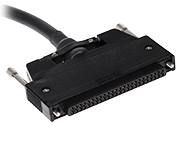
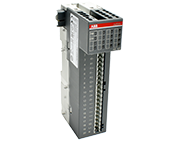
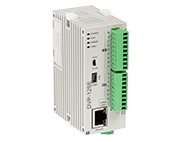
Galco's PLC offering includes compact and modular programmable logic controllers, along with PLC expansions and PLC accessories, so designers and maintenance teams can match I/O count, communication options, environmental ratings and mounting style to each application.
Frequently Asked Questions
Can a PLC control both digital and analog devices?
Yes. Most PLCs accept digital inputs, analog inputs, and provide digital or analog outputs. Digital I/O is used for sensors, switches, relays, and simple actuators, while analog I/O is used for variable signals such as temperature, pressure, flow, or speed. If the base PLC lacks analog channels, expansion modules can usually be added.
Is a PLC only for large industrial systems?
No. Compact and modular PLCs are commonly used for smaller machines, single-process automation, packaging lines, building automation, material handling, and many stand-alone systems. Larger rack-based PLCs are used when high I/O counts, advanced communications, or multiple coordinated machines are involved.
Can PLCs communicate with SCADA or HMI systems?
Yes. PLCs often include Ethernet, serial, or fieldbus communication ports that allow them to share data and receive commands from SCADA and HMI systems. This enables centralized monitoring, alarm handling, remote access, and historical data collection.
How can I determine the right size PLC for my application?
Start by estimating the number of inputs and outputs required, the type of signals, and the need for analog channels or specialty modules. Then consider communication protocols, future expansion, environmental conditions, and required processing speed. For growing systems, modular or rack-mount PLCs are usually the best option.