
Metal Oxide Varistors
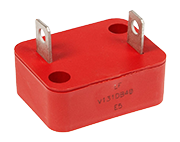
Metal Oxide Varistors (MOVs) for Transient Voltage Suppression
A metal oxide varistor (MOV) is a passive component whose resistance changes with applied voltage. MOVs are used to help protect circuits from transient overvoltage events-short spikes caused by switching, inductive loads, lightning-induced surges, or utility disturbances. In industrial systems, MOVs are often used as a first-line surge clamp to help keep sensitive electronics operating within safe limits. For related parts families, browse Electronic Components and Circuit Protection.
MOVs are the most common type of varistor because they provide strong transient suppression in a simple, rugged package. During normal operation, an MOV stays mostly non-conductive. When voltage rises above its threshold (often discussed as clamping behavior), the MOV rapidly becomes conductive and behaves like a shunt path that diverts excess energy away from the protected circuit, dissipating that energy as heat. This is why MOVs are placed where spikes are expected-typically near the equipment input or across loads that generate switching transients.
To choose the right MOV, focus on the specs that actually change the outcome. Start with the maximum continuous operating voltage (MCOV) so the MOV won't conduct during normal line or DC conditions. Then evaluate the clamping level (how high voltage can rise during a surge), and confirm the MOV can survive the event using its surge current and energy ratings (often the difference between "it protected once" and "it protects repeatedly"). MOVs also degrade with repeated surges, so coordinating them with upstream protection (fuses/breakers) and overall surge strategy is part of good design practice-especially in panels and power distribution contexts under Power & Electrical.
MOVs are commonly used in industrial controls and power electronics where switching noise is unavoidable-drives, motor circuits, contactors/relays, and power supplies. They're also frequently paired with complementary suppression parts: RC networks and capacitors can help reduce ringing and dv/dt stress, while resistors are often part of damping and snubber behavior. For broader system context where these components live, see Automation & Control and Motors, Drives, and Accessories.
- Protect sensitive electronics from spikes: choose an MOV with an MCOV above normal operating voltage and clamping appropriate for the downstream device limits
- High-surge environments: prioritize surge current and energy ratings to survive repeated events
- Switching transients and inductive loads: consider pairing MOV protection with RC networks and capacitors to reduce ringing and stress
- Noise/damping components: integrate resistors where the circuit needs controlled discharge or damping behavior
Frequently Asked Questions
What is a varistor, and how is an MOV different?
A varistor is a voltage-dependent resistor that becomes more conductive as voltage increases. An MOV (metal oxide varistor) is the most common varistor type used for transient suppression because it can absorb significant surge energy and clamp voltage spikes in industrial environments. For adjacent component families often used in protection circuits, see Circuit Protection and Electronic Components.
How do I choose the right voltage rating for an MOV?
Start by matching the MOV's MCOV so it stays non-conductive during normal operation (including expected high-line conditions). Then review the clamping behavior to ensure the protected device won't see damaging voltage during a surge. This selection approach is especially important in Power & Electrical systems where line variation and surge exposure are common.
Do MOVs wear out over time?
Yes. MOVs can degrade after repeated surge events because they dissipate energy as heat. A device that has taken multiple hits may clamp less effectively or fail, which is why many protection designs coordinate MOVs with upstream elements and system-level protection. For broader protection strategies, review Circuit Protection.
When should I use an MOV versus an RC network?
MOVs are typically used to clamp high-energy voltage spikes. RC networks are commonly used to shape and damp switching behavior (reducing ringing and dv/dt stress) rather than absorbing large surge energy. In many industrial designs, both are used together, often alongside capacitors and resistors, depending on the switching environment.
Where are MOVs commonly used in industrial equipment?
MOVs are often used at equipment inputs, in power supplies, and around switching/inductive loads where transients are common, such as motor and drive systems, relay/contactor circuits, and control panels. For related system components where surge events frequently occur, browse Automation & Control and Motors, Drives, and Accessories.