
RC Networks
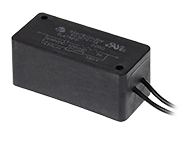
An RC network, or RC circuit, is a resistor-capacitor circuit device used to filter a signal by blocking certain frequencies and allowing others to pass. RC circuits can also be used to minimize the chance of arcing and reduce noise in a href="https://www.galco.com/products/relays-1.html">relay and switching applications.
RC networks consist of a combination of resistors and capacitors connected in series, the simplest being one resistor and one capacitor. The arrangement of the resistor and capacitor in the circuit determines the device's output and gives the RC network its primary operating characteristic.
The most common RC networks are high-pass filters and low-pass filters. High-pass filters attenuate low-frequency signals and protect sensitive circuits from direct current. Low-pass filters attenuate high-frequency signals and smooth or remove short-term fluctuations.
RC networks combine resistance and capacitance in a single package to support common circuit functions such as filtering, timing, and noise reduction. They are used in control, automation, and electronic components where consistent component matching and compact layout are important. If your application includes power electronics, you may also want to review Power Modules.
Types of RC Networks
- RC networks used for filtering and signal smoothing in control circuits.
- RC networks used for timing and delay functions in electronic designs.
- RC networks used for noise suppression and transient reduction in sensitive circuits.
Key Selection Criteria for RC Networks
Choosing the correct RC network requires evaluating several technical factors:
- Resistance and capacitance values needed for the desired time constant or filter response.
- Tolerance and stability requirements for consistent circuit behavior.
- Voltage rating appropriate for the circuit environment.
- Package style and footprint compatible with your assembly method.
- Operating temperature and environmental requirements.
Selecting an RC network that matches electrical requirements and layout constraints helps support predictable circuit performance. For system-level troubleshooting, some teams also use Oscilloscopes during verification.
Frequently Asked Questions
What are RC networks used for in electronic circuits?
They are used for functions such as filtering, timing, and noise reduction by combining resistive and capacitive elements in a matched, compact component.
How do I choose resistance and capacitance values?
Start with the circuit function you need, such as a time delay or a filter response, then select values that produce the time constant or cutoff behavior required. If you validate timing or signal shape, Oscilloscopes can help support circuit verification workflows.
When should I use an integrated RC network vs. discrete components?
Integrated RC networks are useful when board space is limited, matching matters, or you want a simplified bill of materials compared to using separate resistors and capacitors.