
Rheostats
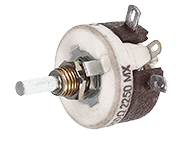
Rheostats for High-Power Manual Current Control
A rheostat is a variable resistor used to control current in a circuit. Rheostats are closely related to potentiometers, but they are typically used with two connections (one end of the resistive element and the wiper). In this configuration, a rheostat acts as a variable series resistance to increase or decrease current, rather than serving as a three-terminal voltage divider. For broader options across this product family, browse Electronic Components.
Because rheostats control current by turning electrical energy into heat, they are usually built to handle substantial current and power dissipation. That's why they still show up in practical, hands-on applications like manual power control, basic light dimming, and coarse motor speed or output adjustment, especially where a simple, rugged control is acceptable and frequent fine adjustments are not required. In many modern systems, electronic controllers handle these jobs more efficiently, but rheostats remain useful when "simple manual control" is the priority and heat dissipation is acceptable.
To reduce confusion, it helps to separate "rheostat types" by how they're installed and how they'll be adjusted. Many rheostats are effectively power resistors with a movable wiper, often used in panel or equipment setups where the component can safely dissipate heat. If you need precision setpoints or stable low-power adjustment, you're usually better served by a potentiometer. If your goal is fixed current limiting or signal shaping with no adjustment, you're typically in resistor territory instead.
Selection usually comes down to a few decision points: required resistance range (Ω), expected current, and, most importantly, power rating (how much heat the rheostat must safely dissipate). Also consider the duty cycle (how long it will operate under load), mounting style, and environmental factors (dust, vibration, airflow). For motor and blower-style use cases, rheostats are most commonly a "manual trim" approach; for broader control components and related hardware, review Motors, Drives, and Accessories and Automation & Control.
- Manual current control: use a rheostat when you need a simple, adjustable series resistance and can tolerate heat dissipation
- Voltage divider / setpoint control: use potentiometers for three-terminal voltage division and finer operator setpoints
- Fixed current limiting: use resistors when no adjustment is needed
- Lighting-related control: for broader lighting components beyond manual resistance control, browse Lighting & Indication
- Motor and fan applications: rheostats may be used for infrequent manual adjustments in pumps, fans, and blowers; for related components see Motors, Drives, and Accessories
Frequently Asked Questions
What is the difference between a rheostat and a potentiometer?
A rheostat is typically used as a two-terminal variable resistor to control current in series with a load. A potentiometer is commonly used as a three-terminal device to divide voltage and set a control signal or reference level. If you need a stable setpoint or signal adjustment, a potentiometer is usually the better fit.
When is a rheostat the right choice today?
Use a rheostat when you need simple, manual adjustment of current, and the system can safely dissipate the heat produced. They are often used for coarse control where adjustments are infrequent, such as manual tuning of certain loads, or legacy equipment where the design already expects a resistive control element. For modern control approaches and related components, browse Automation & Control.
How do I size a rheostat for my application?
Start with the required resistance range (Ω) and expected current, then confirm the power dissipation requirement (wattage). Because rheostats intentionally burn energy as heat, undersizing wattage can lead to overheating or failure. If you are comparing alternatives, fixed resistors may be safer for non-adjustable designs, while potentiometers fit low-power adjustable setpoints.
Can a rheostat be used as a voltage divider?
In most applications, a rheostat is wired as a two-terminal variable resistor to control current, not as a three-terminal voltage divider. If your goal is to set an output voltage or reference level (rather than limit current through a load), a potentiometer is typically the more appropriate choice.
What are common applications for rheostats?
Rheostats are used for manual current control in applications like basic power control, some light dimming scenarios, and certain motor or blower adjustments where frequent fine control is unnecessary. For related hardware and control components used in these environments, browse Motors, Drives, and Accessories and Lighting & Indication.