
Encoders
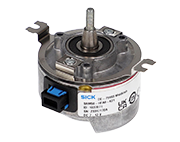
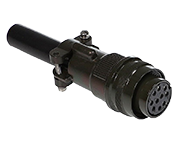
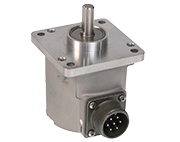
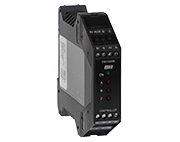
Industrial Encoders for Position Feedback and Motion Control
An encoder is a feedback device used to sense position, orientation, or motion in automated systems. Encoders provide active feedback signals that allow control systems to monitor and regulate motor speed, shaft position, and machine movement with high accuracy. These devices convert mechanical motion into electronic signals that can be processed by controllers such as PLCs, motion controllers, or servo drives.
There are two primary encoder types: rotary encoders and linear encoders. Both detect position and convert mechanical movement into electrical output signals for closed-loop control applications.
Rotary encoders measure the angular position or rotational speed of a shaft. These devices are commonly used in applications requiring precise speed regulation or position tracking, such as conveyor systems, robotics, packaging equipment, and machine tools.
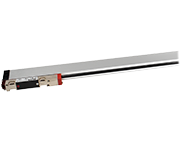
Linear encoders measure position along a straight path using a scale or reference track. Linear encoders are widely used in automation systems where accurate, high-speed motion is required, including CNC machinery, inspection equipment, and positioning systems.
Encoders are further classified as absolute encoders and incremental encoders.
Absolute encoders provide a unique digital position value at every shaft angle and retain position information even after power loss. Incremental encoders generate pulse signals that must be counted relative to a reference position to determine motion or displacement.
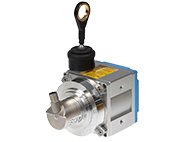
Additional encoder technologies are used for specialized applications. Wire draw encoders measure linear displacement using a retractable cable mechanism and are commonly used in material handling or large motion systems.
Encoder installation and system integration often require supporting components such as direct connection cables to transmit signals reliably, and encoder interface modules to condition signals and enable communication with control systems.
Proper encoder selection depends on resolution requirements, environmental conditions, mounting configuration, output signal type, and system compatibility. Accurate feedback devices are essential for maintaining motion precision, improving automation performance, and reducing mechanical wear in industrial systems.
Frequently Asked Questions
What is encoder resolution and why is it important?
Resolution refers to the smallest measurable motion increment. Higher resolution improves positioning accuracy and motion control performance.
What mounting considerations are important for encoder installation?
Proper shaft alignment, coupling selection, mounting rigidity, and cable routing are critical to ensure accurate measurement and long service life.
How do rotary encoders measure shaft rotation?
Rotary encoders use optical, magnetic, or capacitive sensing technologies to detect shaft movement and generate output signals proportional to angular displacement.