
Light Curtains
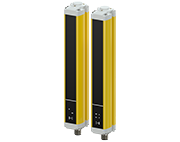
Light curtains protect personnel from injury and machines from damage by creating a light screen that guards access points and perimeters. If the screen is broken or blocked, any connected devices or machinery will shut off.
Light curtains work by sending several beams of light from a transmitter to a receiver. If any beam is interrupted, a signal is sent to the machine's control panel to turn it off. When the connection is reestablished, an automatic reset signal is sent to the control panel to resume operation.
Light curtains can be configured to detect fingers, hands, or whole body parts, based on increasing beam resolution. Blanking and muting are also possible, so the light curtain can permit the entry of certain items (like boxes) and deny others (like hands).
Types of Light Curtains
Light curtains are used for presence sensing and safeguarding at machine access points. They help reduce risk by detecting entry into hazardous areas and triggering a safety response based on the control system design.
- Safety light curtain pairs (emitter/receiver) for guarding openings and access points.
- Systems selected by protective height and sensing range requirements.
- Configurations that support different installation and integration needs.
For floor-based detection, compare Safety Mats. For safety circuit monitoring, review Safety Relays.
Key Selection Criteria for Light Curtains
- Protective height and sensing range required for the guarded opening.
- Resolution requirements (object detection size) based on the hazard and application.
- Response time and integration requirements with safety controls.
- Environmental needs (dust, coolant, vibration) and mounting constraints.
- Alignment/installation considerations and maintenance access.
Matching protective height, resolution, and integration requirements helps support effective guarding and reliable detection.
Frequently Asked Questions
What are light curtains used for?
They are used for non-contact presence detection to safeguard machine access points and hazardous areas.
How do I choose protective height and range?
Protective height should cover the access area, and the range should match the mounting distance. Select based on the guarded opening and installation layout.
When should I use safety mats instead?
Use safety mats when floor-based presence detection fits the layout or when stepping into a zone should trigger a stop.
