
Handheld Tachometers
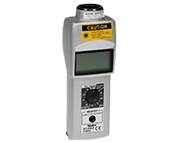
A tachometer is an instrument that measures the rotation speed of a shaft or disk. They are commonly used to measure the revolutions per minute of motors or other rotating machines.
Handheld tachometers are generally classified as contact-type meters and can be held against a rotating shaft to determine speed. Other measurement methods available on handheld tachometers include laser and optical coupler methods.
Handheld tachometers are frequently chosen when testing needs to be performed rapidly and often. Modern devices can measure up to 100,000 RPM and are accurate to within 6 thousandths of a percent. Other options are less accurate but can measure from several feet away.
Types of Handheld Tachometers
Handheld tachometers measure rotational speed for motors and rotating equipment. They are used in maintenance verification and diagnostic workflows where RPM readings support equipment checks.
- Contact tachometers are used when direct contact measurement is practical.
- Non-contact tachometers are used when contact is difficult or unsafe.
- Models designed for repeated route-based maintenance checks with memory features.
If you need visual observation of motion instead of a numeric RPM reading, compare stroboscopes. For broader condition monitoring, compare vibration testers.
Key Selection Criteria for Handheld Tachometers
- Contact vs. non-contact measurement style appropriate for your equipment.
- RPM range and accuracy requirements.
- Ease of obtaining stable readings and display readability.
- Portability and durability for field use.
- Memory or data capture needs for repeatable inspections.
Selecting the right tachometer supports consistent RPM verification and more efficient troubleshooting.
Frequently Asked Questions
What is the difference between a tachometer and a stroboscope?
A tachometer provides RPM readings, while a stroboscope helps visually observe motion and rotational behavior using controlled flashing light. The best choice depends on whether you need a numeric reading or a visual observation.
When is non-contact RPM measurement useful?
Non-contact measurement is useful when direct contact is difficult, when access is limited, or when you want to avoid touching rotating equipment during checks. For related checks in rotating equipment programs, compare vibration testers.
What should I compare when choosing a handheld tachometer?
Start with measurement style and RPM range, then compare accuracy, usability, durability, and whether you need memory or logging features for your workflow. If you need observation rather than readings, compare stroboscopes.
